
(via)
(via)
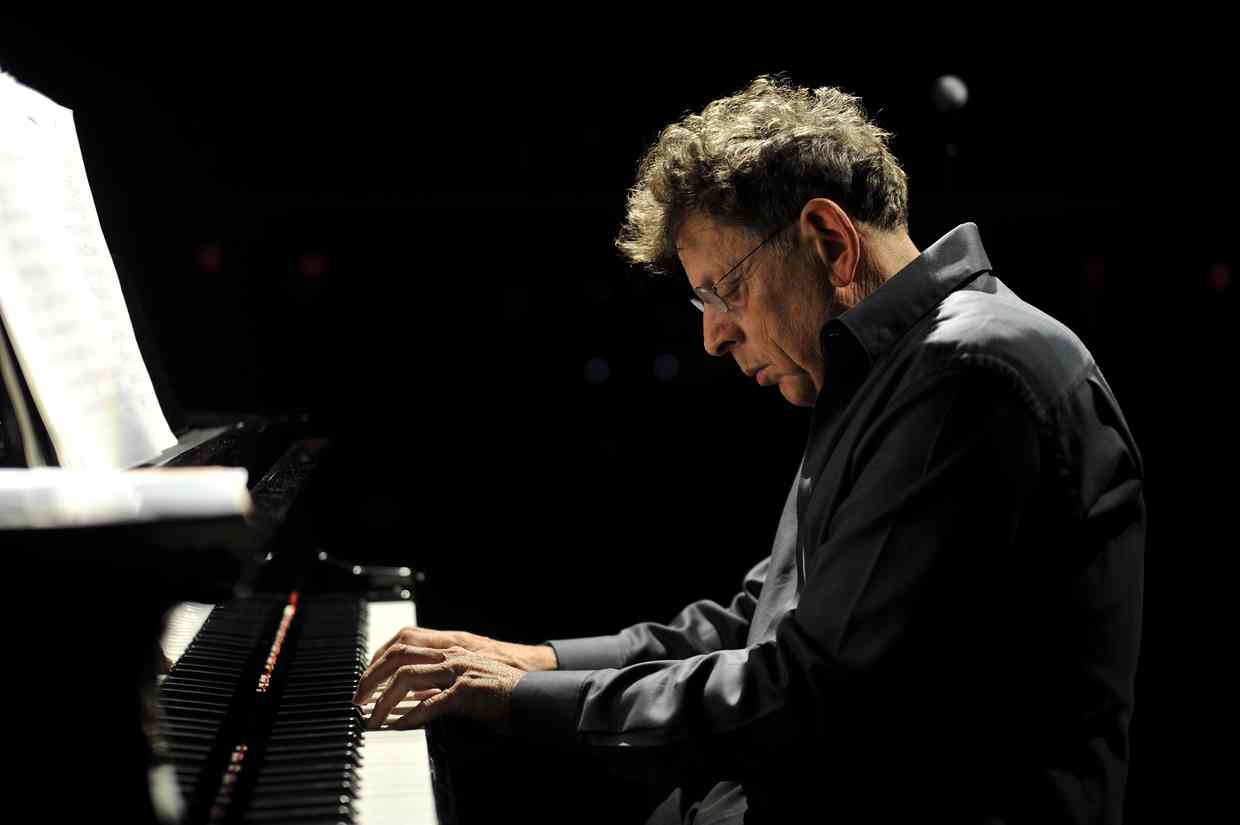
It seems that no one – not you, or Steve Reich, or John Adams – likes being called a minimalist. What do we call you if not that?
Let’s talk about this. The problem is no one is doing minimalism now. It’s music we wrote in the 1970s. It’s over 30 years out of date. It’s a crazy idea to use a description made up by journalists and editors to cover all kinds of music. It’s more confusing than descriptive. What do I really do? Listen to me. I’ve written 26 operas, 20 ballets, I don’t know how many film scores. I write theatre music. I write concert and symphonies too. I’m working on a new film score right now. Then I’ll start a new stage piece. My problem is people don’t believe I write symphonies. But I’m premiering Symphony No 11 in a couple of weeks. These are all different forms of music. Maybe I do too many things.
But it’s the description that sticks: Philip Glass, the great American minimalist…
If people called me an American opera composer it would have the virtue of being what I actually do. This is reality. God forbid we should be accurate. I’m not making this stuff up. Would it be easier to say I’m an Icelandic composer who writes serial music? Would that be helpful? [Silence, then laughter.] I’m a theatre composer.
A lot of people want to hear my music of the 1970s and 1980s. And do you know what I do? I play it. I talk to Paul Simon or anyone like that and it’s the same. I say, “what do you play live, Paul?” and he says “I play my new songs and I play my hits”. And it’s true. If you go to hear Paul Simon, you want to hear Bridge Over Troubled Water. The new work, by the way, is beautiful, but it’s not why you buy the ticket. You want to hear the old ones. It’s the same for me when I play with my ensemble [the Philip Glass Ensemble]. We’ve been together 40 years. We play the familiar stuff, the highlights.
So you’re saying, then, you play… minimalism!
Well, yes, I admit I am part of the confusion. We’ve reworked a piece from 1971. And, guess what, it’s minimalist! OK OK OK, I’m just as bad as the journalists [more laughs].
(via)

So how do you get the attention of the Spotify editorial team? Well, the old “who-you-know” methods still apply: connected publicists, managers, labels, distributors, digital promotion experts, etc. — people in the industry that have the ear of a Spotify playlist curator or two.
But there’s another way, one that doesn’t require you to have connections or a big promotion budget: start DIY, get your songs onto lots of smaller playlists, and begin teaching Spotify’s algorithm to be on the lookout for more song activity from you.
The more activity your songs get, and in particular, the more your songs are added to playlists, the more likely it becomes that Spotify’s editorial team will take notice.
These are Spotify playlists managed by third parties, such as Pitchfork, or major-label playlists such as Topsify.
Just what they sound like: you create them, you promote them, and (assuming you’re verified) you feature them on your artist discography page!
(via)

Who or what inspired you to take up composing, and pursue a career in music?
I started playing the flute at quite a young age and, once I figured out how to read music I realised that I could put notes together how I wanted to and saw that this could be as much or more fun than just reading other people’s. This was possible only thanks to the free tuition and instrument loan that state schools offered back then: I was extremely lucky to attend the Centre for Young Musicians in Pimlico (then run by the Inner London Education Authority). Now, after many years, I am very happy to be an Honorary Patron of the CYM.
Who or what were the most significant influences on your musical life and career as a composer?
I think that, as a teenager, seeing Michael Tippett quite a lot at concerts – hearing new works by him and hearing him talk about them before the performance – had a huge impact on me. It was vital in making me realise that composers are living people and that their imaginations are shaped by the world we all live together in.
(via)

No matter how famous you are as a classical performer, you’re not going to rival Beethoven for recognition.The first step in getting views is knowing what your audience will click on.
We’ve found filming performers is more about what viewers don’t see than what they do.
It’s incredible how astute people are when they are watching video.
We know the “Where?” and the “When?” from point 1. But what about the “Why?”
We all know what a person, sitting at a piano, playing, swaying backwards and forwards looks like.
(via)

How deeply and accurately you feel this underlying heartbeat determines how strongly everyone else will respond to the music.
I cannot tell you how many times I have been in a rehearsal with someone who does not have a clue what key they are in. It’s critical that you know this, because everything you play comes from a key whether you know it or not – and if you don’t know, you may find yourself being that guy in the band who seems to have five heads.
Once you know the tonality you are in, you can use the pitches and interval relationships inside it to create harmony. Harmony is created anytime you make the listener hear two or more pitches at the same time.
(via)