MUSIC
5 Simple Ways to Drive More Video Views on YouTube

How Did Beethoven Compose His 9th Symphony After He Went Completely Deaf?
Why Study Music? Albert Einstein Answered.
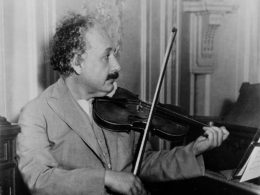
Albert Einstein, at or near the top of anyone’s list of “greatest scientists of the twentieth century,” revolutionized science with his theory of relativity. And what did he have to say about this discovery?
The theory of relativity occurred to me by intuition, and music is the driving force behind this intuition. My parents had me study the violin from the time I was six. My new discovery is the result of musical perception.*
According to Einstein’s sister, Maja: “After playing piano, he would get up saying There, now I’ve got it. Something in the music would guide his thoughts in new and creative directions.”**
And he told one of the founders of Gestalt psychology, Max Wertheimer (who wrote Productive Thinking, one of the classics about the creative process), that he never thought in logical symbols or mathematical equations, but in images, feelings, and even musical architectures.***
(via)
Listen To Tony Conrad’s Avant-Garde Piano Composition, “Music & the Mind of the World”
An Animated Bill Murray Sings About Positivity in the Music Video for ‘Happy Street’ by Paul Shaffer
The Neuroscience of Music

When it comes to music and the human brain, Daniel Levitin’s expertise is hard to top. The musician, professor, and neuroscientist quite literally wrote the book on the topic when he penned the 2006 bestseller This is Your Brain On Music. His most recent book The Organized Mind furthers his exploration into our brains with a focus on how information overload is affecting cognition and what we can do it about it.
You’ve been working on some new research into music and people’s lives at home. What are some of the most interesting or unexpected things you’ve learned about how music—or the lack thereof that affects our lives at home?
Levitin: I think one of the most interesting things is the number of people who really don’t have music playing in their homes. It’s quite striking across the nine countries we surveyed. Something as simple as entertaining friends and family: 84% of people in Sweden, 83% of people in the U.K., 79% of people in the U.S. don’t play music when they have friends over. That just seemed surprising and weird to me. I’m of the Boomer generation, so music was just something that you did and it’s the way that you related to other people, and even the generation behind me. These are people from all age brackets. It’s not just the digital natives who aren’t playing music. Nobody is.
Other activities like cooking dinner, doing the dishes, relaxing in the evening and weekend. In Denmark, 69% of people and in France 82% of people did not listen to music to relax for the evening or the weekend. That was one thing that was surprising. The other is the yearning that people have for more contact, juxtaposed with the amount of time they spend in their own isolated, digital words. 86% want to spend more time doing activities in person with others. It’s as though two wheels are in a rut and they can’t figure out how to get back on the road that they used to be on. We’ve got to encourage people to take screen-time breaks and to establish shared spaces in the home where they can enjoy communal activities.
(via)