INTERVIEW
Interview ~Vladimir Shklyarov (Principal Dancer Mariinsky Ballet)

When did you start dancing?
I’ve suffered since childhood — my Mum wanted me to do it.Why did you start dancing?
Because I was forced to… I didn’t want to!Which performers inspired you most as a child?
Soviet cinema performers Yuri Nikulin and Andrei Mironov.Which dancer do you most admire?
Vladimir Varnava.What’s your favourite role?
Romeo.What role have you never played but would like to?
Des Grieux in Manon.What’s your favourite ballet to watch?
Don Quixote with Mikhail Baryshnikov.Who is your favourite choreographer?
Yuri Smekalov.Who is your favourite writer?
Fyodor Dostoyevsky.Who is your favourite theatre or cinema director?
For movies, Tarantino — for the theatre, Lev Dodin.Who is your favourite actor?
Danila Kozlovsky.Who is your favourite singer?
Zemfira.What is your favourite book?
The one I’m reading.What is your favourite film?
Django Unchained.Which is your favourite city?
St Petersburg.What do you like most about yourself?
I’ll leave that for others to say…What do you dislike about yourself?
I am very impulsive.What was your proudest moment?
Creating my family!
(via)
We Three Risk-Takers Changed The Sound Of Music
Jordi Savall: I was part of a group of artists who decided to take risks. And thanks to that, today, a variety of music has been recognized and has become part of the classical repertoire. This may have been possible because, at one point, someone like Leohardt decided he had to play with a harpsichord and not a piano; or someone like Harnoncourt who decided he would direct certain repertoire in a particular way. And I decided I would play the viola da gamba as I thought it should be played. I think I’ve been very consistent in my life and my way of making music. I started making music with Gustav Leonhardt when he created La Petite Bande, playing baroque repertoire with Anner Bylsma and Sigiswald Kuijken. I was in the creation of The English Concert, with Trevor Pinnock and Stephen Preston and I travelled every week from Basel to London to play with them. It was Nikolaus Harnoncourt who recommended me to substitute my teacher at the School Cantorum in Basel, in the subjects of chamber music and viola da gamba. It was a period in which each of us, in our own way, contributed to learn that music is not only important for what it means within the story but also has a value for what it can provide today.
(via)
Watch 26-year-old Brad Pitt (Interview 1990)
Natalie Lynn Roy on the Power of Meditation and Visualization

Natalie Lynn Roy, co-founder of C.R.E.A.T.E., a workshop series designed to help artists break through their limiting beliefs.
Douglas Taurel: Do you wake up every morning and think of something specifically or is it on a general whole message trying to connect to?
Natalie Roy: Every person is different but the general rule of thumb for creating a Bhavana for yourself, so that it is successful is that you want to be positive, concrete and specific about what you want.
Douglas Taurel: Can you give an example?
Natalie Roy: Sure. For example, I’m going to visualize how great going to the gym will be today. “I woke up and I had so much energy out of nowhere. It’s like I never felt better. Everyone was super nice to me. I got a free towel, I had the most amazing workout. It was like my lungs kept expanding and growing.”
Douglas Taurel: This is before you even went to the gym?
Natalie Roy: That’s right. Before I even go to the gym. You talk and visualize how you want your workout to feel and go. You expect it to go the way you visualize it.
Douglas Taurel: It’s a leap of faith. You’re having faith that it’s going to happen.
Natalie Roy: That’s right. Interesting that it feels easy for us to expect negative outcomes but really hard for us to think of positive expectations and outcomes.
(via)
Conversations With Helen Mirren
Designer By Day, Ballet By Night
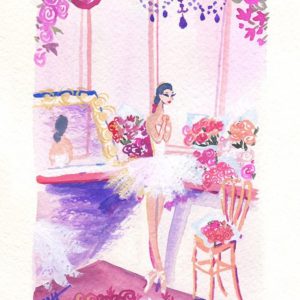
If you are not following @Pointebrush on Instagram, you are really missing out. Meet Margot, a designer and dancer out of NYC, who is re-imagining ballet every day on social media.
Rebecca King: Tell us about your early dance inspiration.
Margot: I was born and grew up in Hong Kong. When I was really young, my mom enrolled me in ballet classes at a small ballet school there. My mom had danced ballet in her youth so I imagine she must have been really excited to have a little girl and promptly brought me to the first ballet class for tots she could find. It was run by an elderly British lady named Carol, sort of a relic from colonial old Hong Kong.
When I was a little older, my mom could see that the training at that school wasn’t all that good for anything beyond young toddlers discovering creative movement so I was moved from this smaller school to a much larger, more vocational school which had a more structured system, and which followed the British RAD syllabus. It came as a real shock to me how strict and academic it was compared to my first school. I learned to do my pliés and tendus properly and every year we had the annual RAD exams where special examiners from the UK would fly in to town specifically to grade and evaluate each student. Because my mom was such a big fan of ballet, she often took me to performances of the Nutcracker, Swan Lake and other ballets that came to town. I even met Marcia Haydee and the great Dame Margot Fonteyn when she visited my school. I had no idea who she was at the time but I remember my mom gushing all about her (I was after all, named after her). My dad is also a huge fan of classical music so beyond just ballet, I developed a love of classical music that I still have to this day.
RK: How did you decide to stop dancing and pursue higher education focused in design?
Margot: Oh how I wish I had never stopped. I don’t think I would have ever gone on to become a professional but having come back to ballet after over a decade, I think quitting in my teens is one of my great regrets. The main reason why I stopped ballet was that the rigid academics of my school just sucked out all the joy and love of dance. It felt for a while like I was a robot just preparing for my annual exams and evaluations without any joy and artistry. It felt very cold and uninspired and I eventually just lost interest. The headmaster of my school sat down with me and my mom at the time and tried to discourage me from leaving but at that point I think I was just over it. I don’t blame the school or the teachers, perhaps I just wasn’t mentally prepared for the academic necessities of higher education in ballet. Ironically, it’s the love of classical music and artistry that brought me back to ballet many years later.
On the other hand, with design and visual arts, it’s always been a part of who I am as a person. Most friends and family remember me as the little girl who could be seated at a table or couch (or virtually anywhere) for hours and hours at a time as long as I had pencils and paper. That’s all I needed. My parents’ dinner guests were always wowed by how I could keep myself entertained for hours on end and they wouldn’t hear a peep from me no matter how late it got. I think deep down, I’ve always known that I’ve wanted to be a designer or artist. I never had an epiphany or made a decisions at any point in my life, I think I had always known all along that visual art in some, way, shape or form was going to be what I did for a living. I never really did anything extra-curricular with my art other than practicing and painting on my own. It’s when I applied to college and was accepted by a design school in New York (Parsons School of Design) that my higher education in art began.
(via)