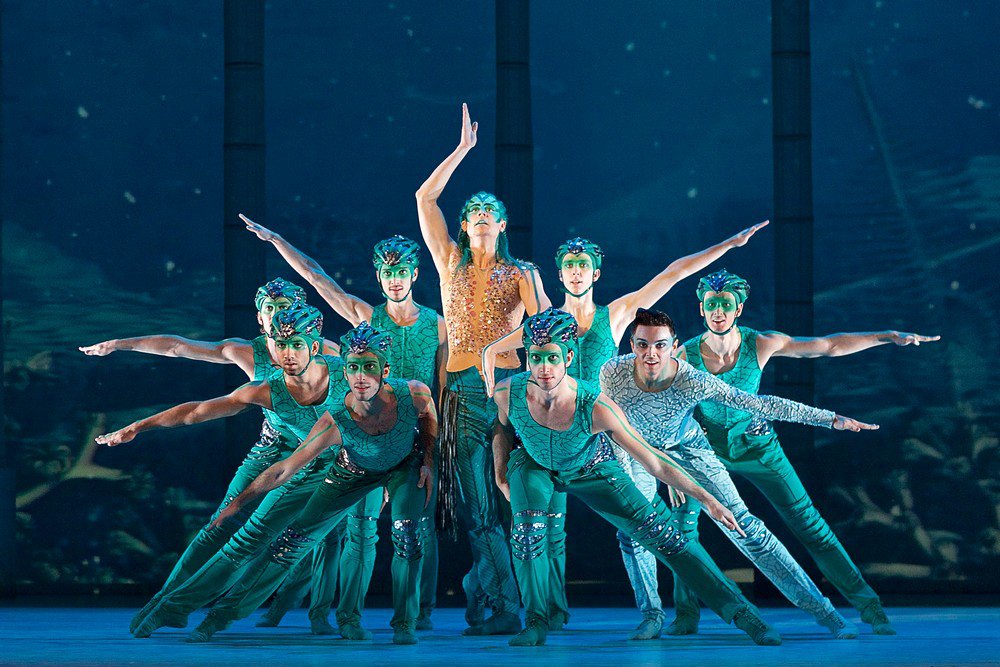

Photographs by Dasa Wharton.
(via)
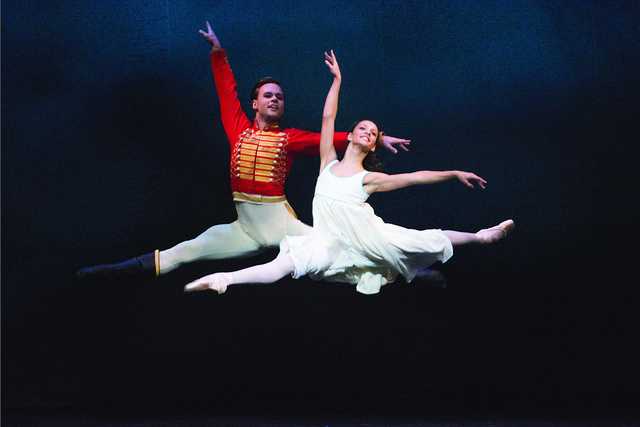
Peter Wright’s production of the quintessential Christmas ballet The Nutcracker will be relayed live to cinemas around the world at 7.15pm GMT on 8 December 2016.
Download your Nutcracker Digital Programme for free using the promo code FREENUT and enjoy a range of specially selected films, articles, pictures and features to bring you closer to the production.
The cinema relay will be presented by former Royal Ballet Principal Darcey Bussell and broadcaster Ore Oduba.
(via)

A year or so ago, Ms. Mearns, one of the most acclaimed ballerinas at New York City Ballet, asked Ms. Melnick, a dancer-choreographer long beloved in the experimental realms of downtown dance, to join her for a residency at Jacob’s Pillow. Ms. Mearns’s City Ballet colleagues Jared Angle and Gretchen Smith came along.
The idea was to experiment with process, not to make a piece. And yet a piece did result, “Working in Process/New Bodies,” which had its premiere on Sunday as part of the Guggenheim Museum’s Works & Process series.
What’s most remarkable about it is how seemingly disparate modes coexist and merge without diminishment, how both sides profit from the exchange. In the past, Ms. Melnick has had trouble translating the idiosyncratic magic of her personal style, slippery and supersubtle, onto other bodies. But these new bodies from City Ballet (Ms. Melnick appears in the work only briefly) bring something different, something their own, and Ms. Melnick doesn’t ignore it.
For despite the ballet steps, “Working in Process” isn’t a ballet. Its vocabulary equally encompasses ordinary movement and Ms. Melnick’s signature gestures: the back of a hand pressed to the forehead, a hip raised and lowered with an action that could cock a shotgun. The aesthetic calls for a sensual inwardness without added sauce, opening up a line of beauty already present in the Balanchine aesthetic of City Ballet. The work reveals an overlap between the glamour and drama of Ms. Melnick and those of Ms. Mearns.
(via)
(via)
Lighting design is an essential part of choreography because it allows the choreographer to control how the audience sees and experiences a work.
The primary objective of lighting is visibility. What do you want your audience to see? For example, to emphasize a soloist, a choreographer my chose to light her with a single pool of down light (a circle of light surrounding a dancer) with the remainder of the stage dark. Most theaters have at least nine pools of down light, arranged in a grid.
It is also possible to light a path (a strip of light running from upstage to downstage), a plane (a strip of light running from stage left to stage right), or a diagonal (a strip of light running from downstage left to upstage right, or visa versa). These various strips of light can emphasize dancers where they are in a corresponding formation.
Most often, a choreographer will have two options for the curtain that hangs in the back of the stage.
If you decide to use colored light, consider what colors will compliment your work. Consider the color of your costumes, and what mood you would like to strike with the audience. In general, warm colors (yellow, red, and orange) can be used to evoke feelings of excitement, warmth, and even anger. In contrast, cool colors (blue, green, and purple) are considered to be more soothing, and can evoke feelings of sadness or romance.
There is never enough time for tech rehearsals. When you arrive at the lighting booth, it is vital to have your lighting cues prepared.
(via)

Goethe once wrote this: “Music is liquid architecture; architecture is frozen music.” For Havelock Ellis—one of the writers on the arts that Martha Graham and Doris Humphrey found inspiring early in the twentieth century—dance and architecture were the sources on which the visual arts were built. Watching one of American Ballet Theatre’s Lincoln Center programs, this dance-music-architecture trifecta chased around in my mind.
This was the program that opened with a revival of Twyla Tharp’s The Brahms-Haydn Variations (2000), continued with the world premiere of Jessica Lang’s Her Notes, and ended with ABT’s premiere of Benjamin Millepied’s Daphnis and Chloe (created for the Paris Opera Ballet in 2014).
The architecture analogy is weakest in regard to Tharp’s ballet, as staged for ABT by Susan Jones, maybe because no one stays still for long, and building-block architecture is avoided. Want an analogy? Try in-process popcorn. When, in canon, men hoist leaping women high, the image of kernels hitting a hot skillet is not entirely untoward. To the orchestral version of Johannes Brahms’s Variations on a Theme by Haydn, waves of people rush onto the stage, rush off again; symmetrical formations yield to asymmetrical ones, sometimes in surprising ways. Classicism is both honored and tweaked. Gallant classical-ballet manners prevail, but people may enter unannounced in the middle of someone else’s major moment and start their own little fire of dancing. There are often people in the background working out their relationship to Haydn, while others prefer the limelight. No tutus, of course, elegantly cut outfits by Santo Loquasto in shades of white, cream, and beige.
(via)