DANCERS
Dancing Across Borders, Blurring the Line Between Hunter and Hunted

This past April, during a residency at The Launchpad in Carbondale, Colorado, Yaa Samar! Dance Theater (YSDT) performed choreography from the initial stages of their newest work, “The Keeper.” Actor Khalifa Natour recited a monologue in Arabic, depicting the first time his character witnesses a John Deere tractor in his village. He mimicked the turning up of earth with his arms and yelled at the sky, his voice both frantic and in awe. Dancer Samaa Wakeem lay on the floor next to him, contorting her body in reaction to his words. Now, during the piece’s third iteration at a residency at Le Théâtre National de la Danse in Paris, “The Keeper” has evolved into a broader contemporary dance theater work, which will be performed on four tons of raw soil that’s been dispersed across the theater’s stage.
This is how YSDT works, relying on residency programs as one of the only opportunities when its performers — who are split between Palestine and New York — can obtain travel documents to come together. The company’s personal struggle with border politics and its innate connection to the Israeli-Palestinian conflict deeply inform their work. “The Keeper” seeks to explore “humanity’s relationship to land as it relates to human survival, culture and identity, and as a source of political conflict.”
(via)
8 Minutes, A Work Inspired By Solar Science Research

Alexander Whitley: I am not trying to explain the science in any way, nor am I doing a piece to explain science: there is no way the body can explain complex scientific ideas, but it can represent them in a certain way, which allows people to engage with the ideas behind the theory. What I’ve come to really appreciate is that physics and dance aren’t so different. They are both about studying and understanding movement. It is just that they ask questions in very different scales; solar physics is about understanding movement of atoms and particles and photons, or something of the size of the Sun itself, which is vastly beyond our comprehension. It has been really interesting to learn about the theory, and behaviour of the movement at these different scales and then ask questions of the body in relation to them, and see how much the body is capable of understanding and expressing those ideas, and so they have thrown a lot to me in terms of different ways of thinking about movement, which has been really exciting.
Alexander Whitley Dance Company performs 8 Minutes at Sadler’s Wells on 27 and 28 June 2017. For tickets and further information visit the Sadler’s Wells website.
Photo Credit: Johan Persson
(via)
How They Became Famous Dancers

How They Became Famous Dancers: A Dancing History for young readers tells the story of twelve famous dancers – six women and six men – from different parts of the world.

A Dance On Freeing The Body From Colonial Time Structures
Dance Moves That Are Scientifically Proven To Be Sexy
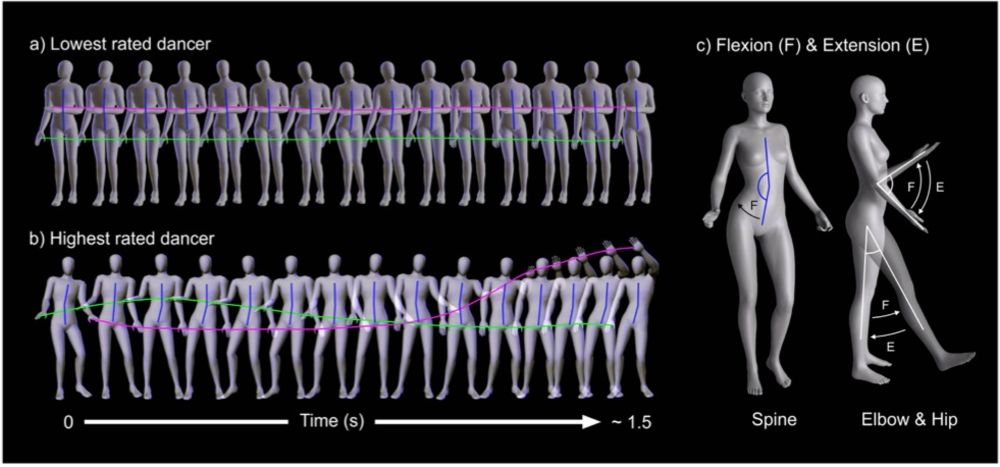
The study was published Thursday in Scientific Reports by a group of researchers based at Northumbria University, who previously identified the sexiest dance moves for men. Whereas the best male dance moves were centralized in the upper body, the best female dance moves centered around the hips, thighs, and arms.
Here’s an example of what the paper found to be a ‘good’ female dancer, performed by an over-sexualized avatar:
(via)
7 Rules For a Highly Effective Movement Practice

1. You are a human being before you are a dancer.
Or an “x”, “y”, or fill in the blank with your activity.
2. Fundamentals are not of lowest level, but of highest importance.
In the world of athlete development there is this thing called the performance pyramid which we can use as a guide for how the flow of an athlete’s training life would ideally look like. Life, however, isn’t ideal, and this is especially true in dance.
3. Move honestly.
Honesty… On all levels of life, it is something I am trying to understand. What is truth? Is honesty the same as truth? What is “truth” when it comes to our bodies in motion, and how does it serve us?
4. If you cannot breathe during the movement, you do not own the movement.
Breath is an incredible built-in indicator of what your body is experiencing (making it an excellent tool for moving honestly). Your emotional state and physical health can be interpreted via the quality of your breath, as well as you ability to load and use core musculature to provide dynamic stability and decelerate spinal motion.
5. Slower is better at first- You can’t do it fast until you master it slow.
Until it becomes an unconscious process, movements often need to be practiced very slowly in order gain competence.
The more slowly you move, the more awareness, the more control, and the more honesty you’ll have in the motion.
6. Get out of your comfort zone, don’t be afraid to make mistakes and fail.
Unfortunately for your sense of pride, failure is how we learn and there’s no way around it.
7. Check-in before and after your practice.
(via)