• Skip to primary navigation
  • Skip to content

RESPIRO E MOVIMENTO®

DISCOVER YOUR REAL POTENTIAL

  • Book a session
  • Events
  • Testimonials
  • Blog
  • Gallery
  • Media
  • Contact

CHOREOGRAPHER

Stage Lighting Basics for Dancers and Choreographers

November 8, 2016 By Respiro E Movimento · Follow us: Facebook · Twitter · Instagram · YouTube

Lighting design is an essential part of choreography because it allows the choreographer to control how the audience sees and experiences a work.

Know Your Objective

The primary objective of lighting is visibility. What do you want your audience to see? For example, to emphasize a soloist, a choreographer my chose to light her with a single pool of down light (a circle of light surrounding a dancer) with the remainder of the stage dark. Most theaters have at least nine pools of down light, arranged in a grid.

It is also possible to light a path (a strip of light running from upstage to downstage), a plane (a strip of light running from stage left to stage right), or a diagonal (a strip of light running from downstage left to upstage right, or visa versa). These various strips of light can emphasize dancers where they are in a corresponding formation.

Select Your Backdrop

Most often, a choreographer will have two options for the curtain that hangs in the back of the stage.

Consider Color

If you decide to use colored light, consider what colors will compliment your work. Consider the color of your costumes, and what mood you would like to strike with the audience. In general, warm colors (yellow, red, and orange) can be used to evoke feelings of excitement, warmth, and even anger. In contrast, cool colors (blue, green, and purple) are considered to be more soothing, and can evoke feelings of sadness or romance.

Be Prepared

There is never enough time for tech rehearsals. When you arrive at the lighting booth, it is vital to have your lighting cues prepared.

(via)

Filed Under: BALLET, BALLET DANCERS, CHOREOGRAPHER, STAGE LIGHTING

Whose Dance Is It Anyway? The Show That Asks You To Guess The Choreographer

October 11, 2016 By Respiro E Movimento · Follow us: Facebook · Twitter · Instagram · YouTube

Unknown pleasures

Unknown pleasures: do we enjoy art more if it’s anonymous?

What kind of value judgments and viewing habits do we bring to the theatre when we are watching a new piece of dance? It’s a question posed by Dance Umbrella and CCN-Ballet de Lorraine in their new, joint production, Unknown Pleasures. By presenting an evening of five new works, whose choreography, design, lighting and music all remain anonymous, they are inviting audiences to look at the stage with their senses rinsed clean of all preconceptions – and all PR.

It’s a bold and engaging experiment, challenging the roles that reputation, context, gender and age play in our evaluation of dance. But much as I enjoyed the novelty of the concept (and the freedom of arriving at the theatre without making any advance preparation)

Photograph by Tristam Kenton.

(via)

Filed Under: CHOREOGRAPHER, CHOREOGRAPHY, DANCE, DANCERS

The Choreographer of “Cats” And “Hamilton” On Trusting Your Creative Instincts

October 6, 2016 By Respiro E Movimento · Follow us: Facebook · Twitter · Instagram · YouTube

cats

How did you first get into the arts?

I grew up in Cincinnati. I remember doing art projects, and I would see such big ideas, but I would only be able to accomplish a draft of it. I always bit off more than I could chew.

With Hamilton, did you ever feel you bit off more than you could chew?

It’s the biggest story I’ve ever told, and the most choreography I’ve ever done. Though I spent less time working on it than I did with Bring It On or In The Heights because Hamilton came to me so evolved already.

In life? What are some examples there?

Later in the show, the family themes. I have two kids, and while creatingHamilton, my daughter was fighting cancer. The whole second act has such resonance for me. It was hard for me to choreograph, it hit so close to home when Hamilton’s son is dying. One of the most simplistic moments in the show is also one of my favorite moments, when Hamilton gets shot in the end. Two men slide next to him and row him across the Hudson. That hit me like a thunderbolt. I can always feel myself carrying my daughter to the hospital. So those things became less about the choreography and more about events that hit home. (Blankenbuehler’s daughter has since recovered.)

(via)

Filed Under: ANDY BLANKENBUEHLER, CATS, CHOREOGRAPHER, THEATRE

A Ballerina Steps Out — as a Choreographer

September 13, 2016 By Respiro E Movimento · Follow us: Facebook · Twitter · Instagram · YouTube

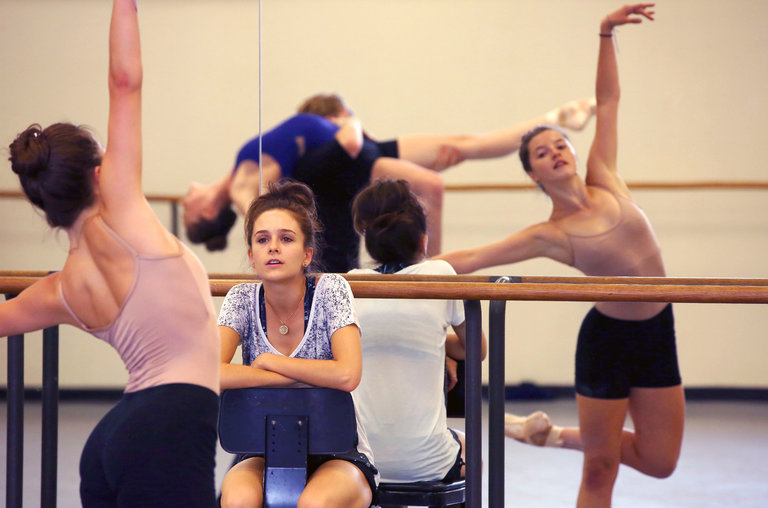
A ballerina steps out as a choreographer

On a recent Saturday afternoon, Lauren Lovette surveyed her dancers before sliding into a split — one of her go-to positions when she’s contemplating a step — and rose suddenly to move through a dynamic passage in her new ballet. She calls this part “soft serve.” In it, dancers line up along a diagonal and pirouette away as their arms swirl above their heads like curlicues topping a dip of Dairy Queen. She made some tweaks; her dancers peeled away from the line with more refinement but no less verve.

“I think that’s going to work,” she said, half to herself. “I believe it.”

Ms. Lovette, a principal with New York City Ballet, frequently uses that phrase when assessing her choreography, which, like her dancing, is lush. “That’s when you know it’s good,” said Indiana Woodward, one of the leads in Ms. Lovette’s new work. “Because she believes whatever you just gave to her.”

This fall, Ms. Lovette, 24, is working from that place of conviction. Ms. Lovette, one of two women who will unveil new works at City Ballet’s fall gala on Sept. 20 — the other is the choreographer Annabelle Lopez Ochoa — is under some pressure.

(via)

Filed Under: BALLET, BALLET DANCERS, CHOREOGRAPHER, NEWS, NYC BALLET

Break The Status Quo When Teaching Dance

August 8, 2016 By Respiro E Movimento · Follow us: Facebook · Twitter · Instagram · YouTube

Wise Moves: deviating from the standard– the usual, the status quo– to ensure impact

Wise Move #1: Know your strengths and stick to them

I don’t yet know her instructor, but I admire her efforts to honestly communicate where her strengths  (or interests) are and knowing where to send students searching for something else.

Wise Move #2: Get specific

We can’t please everyone all of the time and we can sure make ourselves miserable in the process of trying. One example of choosing wisdom is being honest about with whom you do your best work and focusing on that.

Wise Move #3: Seize the opportunity

When I first met with this dancer, within minutes I knew I had a choice. We could spend our time on vocabulary and terminology (which had been the initial request), or I could help her understand her body. There is a lot going on there…lordosis, knock-knees, hyper-extension, rolling ankles, etc.

Wise Move #4: Keep them moving

For this dancer, with this body, I suspect there are instructors out there that would tell her she shouldn’t dance. No one has done that. I have opted to gain the knowledge needed to help such dancers. Her other instructor opted to know where to send her to gain that help.

(via)

Filed Under: BALLET, BALLET DANCERS, CHOREOGRAPHER, CHOREOGRAPHY, DANCE, DANCERS

Women’s Offstage Role in Ballet

August 3, 2016 By Respiro E Movimento · Follow us: Facebook · Twitter · Instagram · YouTube

Ballet is woman

George Balanchine is often quoted as saying, “Ballet is woman.” Though a simple statement, his ballets illustrate a deep love and appreciation of women. Even as his ballets age, audiences are drawn to the way he flawlessly highlighted the beauty of the females who interpret his steps. He is known to offer moments of such simplicity that all the audience can do is admire a ballerina’s beauty.

This is a topic I tackle with fellow Miami City Ballet dancer, Michael Sean Breeden, in this week’s installment of our new podcast, “Conversations on Dance”: why are women are not as prominent in the world of choreography? The professional ballet world tends to be more competitive for women. With most repertoire requiring larger numbers of women, men often find themselves with spare time which some often use to dabble in choreography. Perhaps this explains the larger number of men interested in creating dance.

But it seems to me that the real truth is starting a career in choreography is extremely difficult. Finding the time and opportunity to put your talent to the test is almost impossible. In order to create, a choreographer needs good, willing dancers, studio space, and a venue to showcase the work. A lot of things need to fall into place just for a first big break. That’s why it is often up to teachers or school/company directors, to offer the opportunity. Hopefully in the future this is something the field will work to cultivate.

(via)

Filed Under: BALLET, BALLET DANCERS, CHOREOGRAPHER, CHOREOGRAPHY

The Gender of Choreography. Is It Time for Quotas?

July 21, 2016 By Respiro E Movimento · Follow us: Facebook · Twitter · Instagram · YouTube

 
The audience, Dance Umbrella - Big Dance debate - photo by Tom Simpson
The audience, Dance Umbrella – Big Dance debate – photo by Tom Simpson

Is it time for quotas? This was one of many questions discussed at a Dance Umbrella debate, part of the Big Dance 2016 events, at the beginning of this month.

The subject of gender inequality in choreography has been stirring up a lot of press in recent months. During a panel discussion in October last year, the Rambert Dance Company’s artistic director Mark Baldwin said,

I want Rambert to be a company which is diverse in its choices of choreographers. Programming work by women and choreographers of ethnic backgrounds plays a role. It is about embracing diversity.

The Rambert company certain plays its part with a large proportion of female dancemakers. Of course, you say, where are the female conductors? The cinema directors? True, but as Michael Cooper in the New York Times pointed out,

The dearth of female choreographers at major ballet companies is perhaps more startling, given the prominence of women in the rest of the ballet and dance fields — and the way pioneering female choreographers helped shape ballet during the 20th century.

Jennings, in The Observer, swiftly wrote off a ‘Dear Akram’ letter:

In saying that we should not have more female choreographers “for the sake of having more female choreographers”, you are choosing to disregard a gender imbalance so egregious, and of such long standing, that it shames the British dance establishment.

In the contemporary sphere, female choreographers are routinely passed over for commissions in favour of less experienced men. The more large-scale and high-profile the commission, the smaller the probability that it will be awarded to a woman.

In classical dance, female choreographers face even greater discouragement; no woman has been commissioned to choreograph a main-stage ballet at the Royal Opera House since the 1990s.

(via)

Filed Under: CHOREOGRAPHER, CHOREOGRAPHY, DEBATE

  • « Previous Page
  • Page 1
  • Page 2
  • Page 3
  • Next Page »

Copyright © 2026 · Respiro e Movimento®· All rights reserved

  • Facebook
  • Twitter
  • Instagram
  • YouTube