BALLET
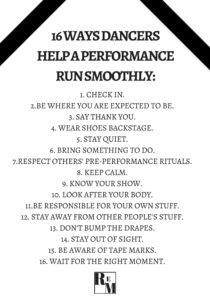
16 Ways Dancers Help A Performance Run Smoothly
Anatomy Of A Pointe Shoe

Back view of a “traditional” pointe shoe.

Top view of a “traditional” pointe shoe.
Irrespective of brand, pointe shoes are typically composed of the same parts. We have illustrated this section with pictures of Capezio Pavlowas:
- Most shoes have a stiff box – or block – made with layers of fabric, paper and glue (very much like papier-mâché), whose stiffness will vary depending on the shoe’s model, width and length.
- As the box extends over the toes, it encases them and gives them a supporting platform upon which the dancer stands.
- Halfway into the foot, the box’s upper layer of satin, leather and/or canvas forms the upperwhich is joined to the outer sole by a series of pleats.
- The area covering the toes is known as the vamp. The edge of the shoe can be lined with adrawstring to help adjust the foot.
- The inner shoe is lined with canvas.
- Underneath the shoe, a small thin leather sole allows for flexibility. Most models have a full sole, but some have split soles or soles combining leather and fibre to increase shoe pliability and improve foot articulation.
- Between the outer and the inner soles a hard spine made of leather or a more resilient synthetic material – the shank – forms the shoe’s core. A full shank runs the length of the sole. Ideally it should be hard yet supple and conform to the dancer’s arch.
(via)
Swan Song

In lines and lakes we gather
beating many hearts as one
In rows and flocks we’d rather
spin a tale that’s nary done
Telling stories from the borders
strength in numbers never fails
Until the roles we hope to realize
doth a time and place avail
We hold the weight of dreams encumbered
by narration’s fateful choice
Which claims the bodies of the corps
to give the higher ranks a voice
As hindsight loves to reason
lives we solely choose to live
Time must past to understand
the value only we could give
Moving onwards to new journeys
rows and lines will start to bend
Corps de Ballet
spells the story of a bond that never ends.
— written on a regional Amtrak; Manhattan bound. 03.27.2016
Photograph by Haroldo Kennedy.
(via)
How To Prepare Yourself For Dancing On An Unfamiliar Stage

Chelsea Bradley, a freelance choreographer based in Madison, Wisconsin, where she teaches contemporary at Monona Academy of Dance and serves as resident choreographer for Dance Wisconsin, gives us the following steps.
1. Find your spot
Spotting is easy in the studio. I often tell my dancers to use the mirror to look themselves in the eyes. However, when there is no mirror, we must adjust. The most common item in convention center ballrooms and theaters are “exit” signs. If there are none, look for non-moving lights or visible signs.
2. Survey the floor
If you are able to look at the stage before you perform, consider the following to visualize the spacing of your choreography:
- Are there wings (and if so, how many)?
- How many strips of flooring (or tape lines) are there?
- Are there markings for center or quarter?
If you will be wearing pointe shoes, always have rosin with you in case the stage appears slippery.
3. Check for distractions
Being aware of these distractions before you dance makes it less likely that they will disrupt your performance.
4. Visualize
Once you have surveyed your external surroundings, it is important to make sure that you are mentally prepared to perform. After you have warmed up, use an mp3 player to listen to your music.
Photograph by Mait Jüriado.
(via)
How To Improve Flexibility
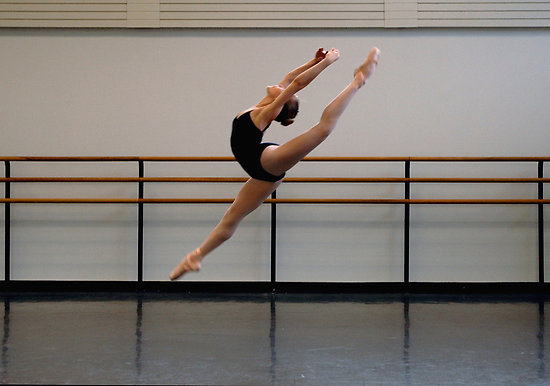
Improve flexibility by performing a few cardiovascular exercises before stretching, in order to loosen up the muscles in the body and increase circulation. Increase flexibility by stretching the legs, quads and hamstrings with tips from a gymnastics coach in this free video on gymnastics. Watch the video below.
The Body Is Living Art

Anna Halprin helped pioneer the experimental art form known as postmodern dance and referred to herself as the breaker of modern dance.