Shakespeare biography has long circled a set of tantalizing mysteries: Was he Protestant or secretly Catholic? Gay or straight? Loving toward
Designer By Day, Ballet By Night
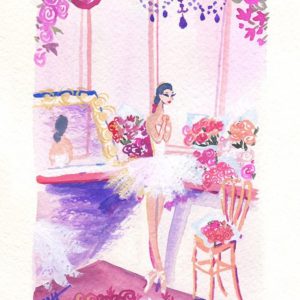
If you are not following @Pointebrush on Instagram, you are really missing out. Meet Margot, a designer and dancer out of NYC, who is re-imagining ballet every day on social media.
Rebecca King: Tell us about your early dance inspiration.
Margot: I was born and grew up in Hong Kong. When I was really young, my mom enrolled me in ballet classes at a small ballet school there. My mom had danced ballet in her youth so I imagine she must have been really excited to have a little girl and promptly brought me to the first ballet class for tots she could find. It was run by an elderly British lady named Carol, sort of a relic from colonial old Hong Kong.
When I was a little older, my mom could see that the training at that school wasn’t all that good for anything beyond young toddlers discovering creative movement so I was moved from this smaller school to a much larger, more vocational school which had a more structured system, and which followed the British RAD syllabus. It came as a real shock to me how strict and academic it was compared to my first school. I learned to do my pliés and tendus properly and every year we had the annual RAD exams where special examiners from the UK would fly in to town specifically to grade and evaluate each student. Because my mom was such a big fan of ballet, she often took me to performances of the Nutcracker, Swan Lake and other ballets that came to town. I even met Marcia Haydee and the great Dame Margot Fonteyn when she visited my school. I had no idea who she was at the time but I remember my mom gushing all about her (I was after all, named after her). My dad is also a huge fan of classical music so beyond just ballet, I developed a love of classical music that I still have to this day.
RK: How did you decide to stop dancing and pursue higher education focused in design?
Margot: Oh how I wish I had never stopped. I don’t think I would have ever gone on to become a professional but having come back to ballet after over a decade, I think quitting in my teens is one of my great regrets. The main reason why I stopped ballet was that the rigid academics of my school just sucked out all the joy and love of dance. It felt for a while like I was a robot just preparing for my annual exams and evaluations without any joy and artistry. It felt very cold and uninspired and I eventually just lost interest. The headmaster of my school sat down with me and my mom at the time and tried to discourage me from leaving but at that point I think I was just over it. I don’t blame the school or the teachers, perhaps I just wasn’t mentally prepared for the academic necessities of higher education in ballet. Ironically, it’s the love of classical music and artistry that brought me back to ballet many years later.
On the other hand, with design and visual arts, it’s always been a part of who I am as a person. Most friends and family remember me as the little girl who could be seated at a table or couch (or virtually anywhere) for hours and hours at a time as long as I had pencils and paper. That’s all I needed. My parents’ dinner guests were always wowed by how I could keep myself entertained for hours on end and they wouldn’t hear a peep from me no matter how late it got. I think deep down, I’ve always known that I’ve wanted to be a designer or artist. I never had an epiphany or made a decisions at any point in my life, I think I had always known all along that visual art in some, way, shape or form was going to be what I did for a living. I never really did anything extra-curricular with my art other than practicing and painting on my own. It’s when I applied to college and was accepted by a design school in New York (Parsons School of Design) that my higher education in art began.
(via)
Leo Nucci Alla Scala – Ballo In Maschera
Shakespeare: Actor. Playwright. Social Climber.

The documents, discovered by Heather Wolfe, the curator of manuscripts at the Folger Shakespeare Library in Washington, relate to a coat of arms that was granted to Shakespeare’s father in 1596, attesting to his and his son’s status as gentlemen.
Considered with previously known records, Ms. Wolfe argues, the documents suggest both how deeply invested Shakespeare was in gaining that recognition — a rarity for a man from the theater — and how directly he may have been drawn into colorful bureaucratic infighting that threatened to strip it away.
Ms. Wolfe’s discoveries began in the archives of the College of Arms in London, home to 10 heralds who are still charged with researching and granting coats of arms — arcane territory where many literary scholars might fear to tread.
(via)
10 Tips For Choosing The Best Monologue For You
- Know your casting type and be realistic about it. A good way of discovering this to ask other people in the industry. If you choose a piece that is something you’d LIKE to do as opposed to something that truly suits you, you are unlikely to stand out among the competition- there will be plenty of others who ARE that particular casting type.
- Know your age range. Again, be realistic about this and ask people in the industry for honest opinions then stick to that age range for your monologue.
- Play to your strengths. It’s great to experiment and try a wide range of monologues to practice but when it comes to what you choose to use for auditions, play to your strengths and show yourself being the best that you can be.
- Choose a monologue with shifts in emotion. The most interesting monologues to watch are the ones with changes in emotion. This will make it more compelling to watch and will show more of what you are capable of.
- Choose one that matches the role you are going for. The closer you can match your monologue to the role you are going for, the better. It’s no use showing how skillful you are at comedy if you are going for a drama.
- If they haven’t specified timings, keep it short. People generally make their minds up in the first few seconds anyway. Keep them wanting more.
- Choose a strong character. It’s easy to switch off if the monologue is about someone who is feeling sorry for themselves and is whinging. Choose feisty, strong roles. Survivors not victims – these are the characters people prefer to watch.
- Do not change your accent. Stick to your own accent. You’ve been invited to the audition because of who you are, and if you deliver your monologue in a different accent, you won’t be giving them what they wanted when they called you in- which is you! The exception to this of course is if you have been asked to do a different accent, and even then only go for it if you are flawless.
- Stick to the present. The most dynamic monologues are those that are in the present where the character has a strong need for something right now, as opposed to reliving a memory.
- Avoid iconic scenes where possible. They will have been seen a million times and people won’t be able to help themselves but to compare you to the actor who performed the original.
(via)
Eye-catching Ways To Play Dead On Stage

It’s why dying badly on stage has become one of the tropes of comedy theatre from the antics of Mischief Theatre’s The Play That Goes Wrong to Spymonkey and Tim Crouch’s The Complete Deaths, in which all 74 stage deaths in Shakespeare’s plays are re-created.
The ancient Greek playwrights knew that it is absence, not an actor covered in fake blood, that makes us understand the permanence of death – and its horror. As Lars von Trier observed in The Kingdom: “Maybe what we’ve shown has troubled you. Don’t be afraid, keep your eyes and ears open. All we can do is try to scare you with stage blood. Only when you avert your eyes have we got you. The real horror lies behind the closed doors.”
(via)
Parsifal


Head-spinning and hilarious, Parsifal is a book like no other about the entanglement of the past and present, as well as the limitations of the future.
There’s a war going on between the earth and the sky, but that doesn’t stop Parsifal, a humble fountain-pen repairman, from revisiting the forest where he was raised. On his journey, Parsifal―a wise fool if there ever was one―encounters several librarians, a therapist, numerous blind people, and Misty, a beautiful woman who may well be under the influence of recreational drugs. Head-spinning and hilarious, Parsifal is a book like no other about the entanglement of the past and present, as well as the limitations of the future.