Happy 70th birthday tenor Josep Carreras.
OPERA
Verdi The Radical: How The Free-spirited Composer Shocked The Opera World
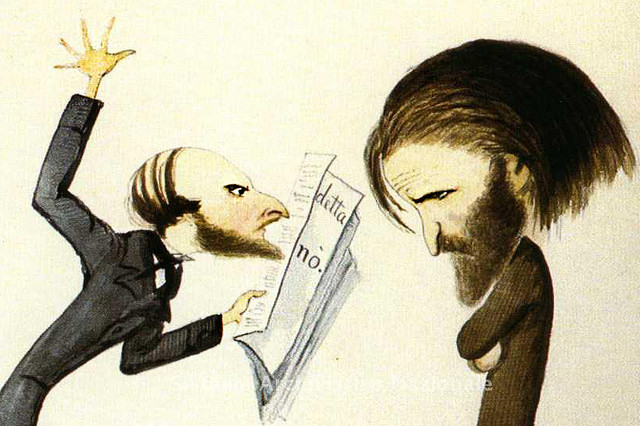
Verdi’s aggressive retort may be understood as yet another facet of an insurrectionist nature: he had, from the very beginning of his creative life, a well-articulated mission to escape and subvert the rigid culture of Italian opera composition and its concomitant mercantilism. The independence and strength of his relationship with Strepponi seemed to intensify that ambition, which he reiterated in a letter of 25 February 1850 to librettist Salvadore Cammarano, regarding a never fully realized opera based on Shakespeare’s King Lear: ‘You know that we should… treat it in an entirely novel manner… without regard to conventions of any kind’.
Such clearly articulated personal and artistic radicalism would soon manifest itself in his choice of outré subjects and situations for the three operas written between April 1850 and March 1853. In Rigoletto (1851), a hunchback’s beautiful daughter is abducted and raped; in Il trovatore (1853), a mad gypsy’s vengeful act of throwing an infant into a fire leads to fratricide; and in La traviata (1853) a consumptive courtesan’s love for a man above her social class climaxes in a passionate reunion and a tragic death.
(via)
English National Opera – L’Amour de Loin – Part 1: Make Dreaming
Josep Carreras ‘Music Isn’t Only A Profession’
How To Discuss Opera Singers Across Time?

The anniversary of Callas’ birth seems an appropriate time to flesh out my long-hoarded thoughts on this subject. For Maria Callas, of glorious memory, of eternally astonishing voice, is often cited as the paragon to crown all paragons.
There’s an astonishing variety of roles for which, in discussions of their performance history, her name is inevitably mentioned, in accents of hushed or ecstatic reverence. She is, for many, the diva, La Divina, ne plus ultra. I’m not exempt from the impulse to adore. Her Tosca was the first CD set I bought for myself, and others have joined it since (there’s a fuller panegyric here.) In part, perhaps, because of her preternaturally polished off-stage glamour, Callas has come to be a potent and multivalent symbol. She is, sometimes, the essential Diva, the goddess, having become the perfect woman by her transcendence — or transmutation? — of female fickleness and frailty. She is, sometimes, the symbol of glories past, never to be attained by the present and degenerate generation. She is, sometimes, the incarnation of opera’s astonishing ability to simultaneously surmount and express the anguish of the human condition.
(via)
Montserrat Caballé “Dove sono” – Le nozze di Figaro
Riccardo Chailly on Puccini’s first Madama Butterfly, soon to revisit La Scala

There is a small exhibition in La Scala’s museum which looks at the theatre’s previous productions of Madama Butterfly, an opera that had its world premiere at the theatre in 1904. What is surprising is that in all the many concepts and designs there has always been a kimono and fan when so many other operas have received the jeans and piercings treatment, or been given the high-tech and laser look. La Scala’s new production by the Latvian director Alvis Hermanis, which opens the season on 7 December, is similarly reserved and respectful; justly so for the return to Puccini’s original score which was reworked many times after its disastrous reception at La Scala at the beginning of the last century.
There are many reasons for this. Certainly, the culture clash between East and West, a 15-year-old seduced and abandoned by a ‘wicked American’, and the two acts instead of three, were all not liked. This was already something anticipated by Richard Strauss and not loved by a public used to the traditional three acts.
(via)