JAZZ
John Coltrane’s Handwritten Outline for His Masterpiece A Love Supreme (1964)

Recorded in December of 1964 and released in 1965, A Love Supreme is Coltrane’s personal declaration of his faith in God and his awareness of being on a spiritual path. “No road is an easy one,” writes Coltrane in a prayer at the bottom of his own liner notes for the album, “but they all go back to God.”
(via)
Interview: Rowan Hudson, Jazz Pianist

What do you consider to be the most important ideas and concepts to impart to aspiring musicians?
I think probably the best advice I could give is very boring – practice the fundamentals. A lot of people (myself included) neglect simple things like having good time, feeling comfortable in difficult keys (and minor keys), ear training, etc. too early in their development and move on to really complex concepts before the fundamentals are really in place. I definitely made that mistake and I now practice mostly quite basic things along those lines. Also, to me there seems to be a bit too much focus on harmony and not enough focus on phrasing and rhythm in Jazz education, maybe that’s just a personal thing. It’s difficult sometimes early on to see the timeline of your playing. The balance between getting the fundamentals together and also trying to find your own sound can be hard. I think most Jazz players now need to have very solid foundations to built on, maybe that wasn’t the case in the past for people like Ornette Coleman, who made his own rules. But nowadays it seems to be pretty hard to get anywhere without good reading, ability to play in different time signatures, ability to play modal tunes, etc. That’s not necessarily a good thing, but I think it is the way things are now.
(via)
Hear the First Jazz Record, Which Launched the Jazz Age: “Livery Stable Blues” (1917)
10 Pieces Of Advice To Young Artists
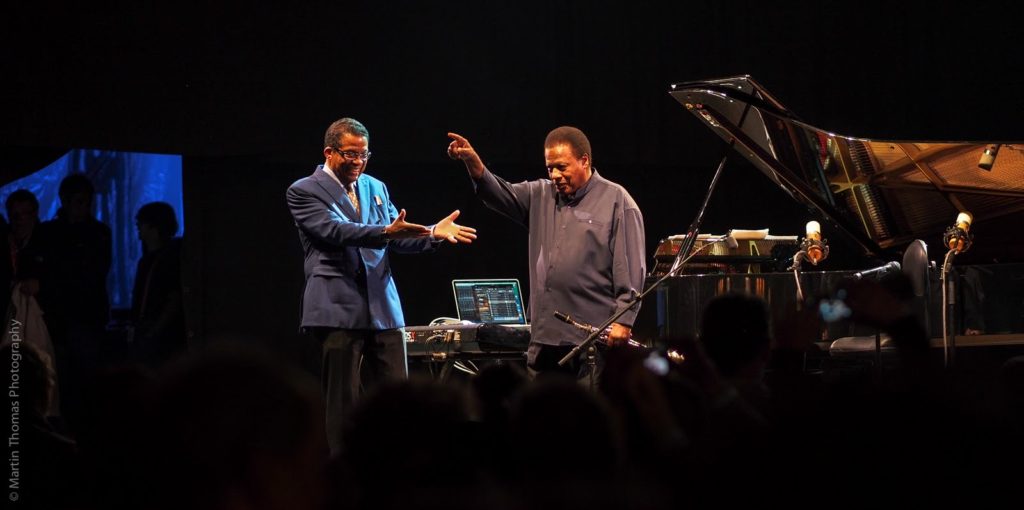
As Wayne Shorter and Herbie Hancock— two of the 20th century’s most consistently innovative musicians—suggest, artists at all times need a set of guiding principles.
First, awaken to your humanity
Embrace and conquer the road less traveled
Welcome to the Unknown
Understand the True Nature of Obstacles
Don’t Be Afraid to Interact with Those Who Are Different from You
Strive to Create Agenda-Free Dialogue
Be Wary of Ego
Work Towards a Business without Borders
Appreciate the Generation that Walked Before You
Lastly, We Hope that You Live in a State of Constant Wonder
(via)
Musician Plays the Top Piano Riffs of Jazz Tunes From 1899 to 1964 in 100 Seconds
The Night When Charlie Parker Played for Igor Stravinsky (1951)

The history of 20th-century music offers plenty of stories of luminaries meeting, playing together, and sometimes even entering into long-term collaboration. But it typically only happened within traditions: encounters between rock and rock, jazz and jazz, modernism and modernism. And so it still thrills to hear of the time in 1951 when Charlie Parker added one more story to the most storied jazz club of all by performing for Igor Stravinsky at Birdland. Alfred Appel tells it definitively in his book Jazz Modernism: From Ellington and Armstrong to Matisse and Joyce:
The house was almost full, even before the opening set — Billy Taylor’s piano trio — except for the conspicuous empty table to my right, which bore a RESERVED sign, unusual for Birdland. After the pianist finished his forty-five-minute set, a party of four men and a woman settled in at the table, rather clamorously, three waiters swooping in quickly to take their orders as a ripple of whispers and exclamations ran through Birdland at the sight of one of the men, Igor Stravinsky. He was a celebrity, and an icon to jazz fans because he sanctified modern jazz by composing Ebony Concerto for Woody Herman and his Orchestra (1946) — a Covarrubias “Impossible Interview” come true.
As Parker’s quintet walked onto the bandstand, trumpeter Red Rodney recognized Stravinsky, front and almost center. Rodney leaned over and told Parker, who did not look at Stravinsky. Parker immediately called the first number for his band, and, forgoing the customary greeting to the crowd, was off like a shot. At the sound of the opening notes, played in unison by trumpet and alto, a chill went up and down the back of my neck.
They were playing “KoKo,” which, because of its epochal breakneck tempo — over three hundred beats per minute on the metronome — Parker never assayed before his second set, when he was sufficiently warmed up. Parker’s phrases were flying as fluently as ever on this particular daunting “Koko.” At the beginning of his second chorus he interpolated the opening of Stravinsky’s Firebird Suite as though it had always been there, a perfect fit, and then sailed on with the rest of the number. Stravinsky roared with delight, pounding his glass on the table, the upward arc of the glass sending its liquor and ice cubes onto the people behind him, who threw up their hands or ducked.
(via)