Former Ballet Mistress Ursula Hageli looks at the development of pointe work in ballet, where the dancers move on the tips of their toes – from Marie Taglioni’s experiments in the 1830s, through developments by Italian and Russian dancers through to the famed pointe work of Russian Classical ballet. With danced demonstrations by Gemma Pitchley-Gale and Fumi Kaneko.
BALLET DANCERS
The 6 Positions Of Ballet

Eating Disorders In Ballet
Capturing A Dancer Out Of Her Environment
Photographer Albert Ayzenberg doesn’t photograph dancers on stage, quite often he doesn’t photograph dancers dancing either, but rather uses the form of their bodies to integrate or contrast with an outside environment. Dancers on the subway, in phone boxes… isn’t it all getting repetitive?
To me it’s a fine art project. Dancers are amazing athletes. You can put a ballerina in any location and make art. But it’s not just about capturing a beautiful silhouette against an interesting backdrop. I like to shoot close-ups. The face and the eyes tell a personal story. I try to capture the essence of the dancer in this way… to portray the whole human being.
I like to think my photos reveal the intimate side of a dancer in a way that a lot of commercial dance photography does not. I hope the audience finds my images both exquisite and very accessible.


(via)
Injury Prevention: Understanding Pain
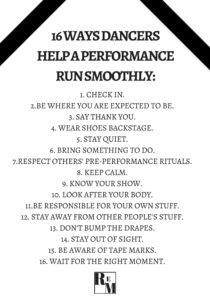
16 Ways Dancers Help A Performance Run Smoothly
Anatomy Of A Pointe Shoe

Back view of a “traditional” pointe shoe.

Top view of a “traditional” pointe shoe.
Irrespective of brand, pointe shoes are typically composed of the same parts. We have illustrated this section with pictures of Capezio Pavlowas:
- Most shoes have a stiff box – or block – made with layers of fabric, paper and glue (very much like papier-mâché), whose stiffness will vary depending on the shoe’s model, width and length.
- As the box extends over the toes, it encases them and gives them a supporting platform upon which the dancer stands.
- Halfway into the foot, the box’s upper layer of satin, leather and/or canvas forms the upperwhich is joined to the outer sole by a series of pleats.
- The area covering the toes is known as the vamp. The edge of the shoe can be lined with adrawstring to help adjust the foot.
- The inner shoe is lined with canvas.
- Underneath the shoe, a small thin leather sole allows for flexibility. Most models have a full sole, but some have split soles or soles combining leather and fibre to increase shoe pliability and improve foot articulation.
- Between the outer and the inner soles a hard spine made of leather or a more resilient synthetic material – the shank – forms the shoe’s core. A full shank runs the length of the sole. Ideally it should be hard yet supple and conform to the dancer’s arch.
(via)